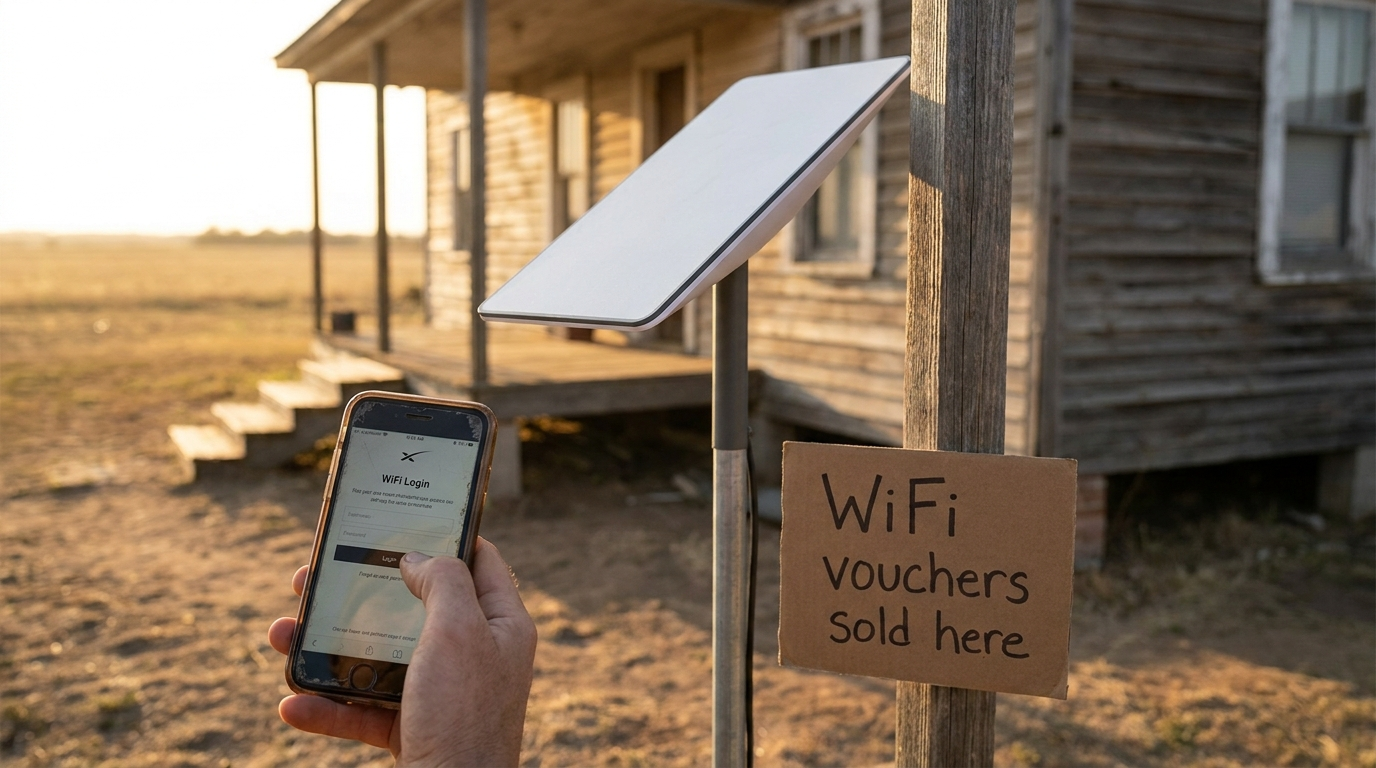

In parts of Nigeria, people now pay Starlink billions of naira every month because local internet providers simply cannot keep up. The same story is playing out across rural Africa, Latin America, island nations, and the back roads of North America. Where there is no decent connection, a single Starlink dish becomes the most valuable thing on the street.
That gap is exactly why so many people are asking the same question: can you make money selling Starlink internet?
The short answer is yes, but not the way most people assume. Casually splitting your home dish and charging the neighbours is against Starlink's rules and can get your account killed. The people who actually earn from Starlink do it through a handful of legitimate routes, and this guide walks through every one of them with real 2026 numbers.
The quick answer
People make money with Starlink in five main ways: becoming an authorized reseller, running a community WiFi voucher business on a proper business plan, offering installation and setup services, deploying pop-up WiFi at events, and earning referral credits. The single biggest mistake is reselling a Residential connection, which Starlink's Terms of Service prohibit outright.
First, the rule you cannot ignore
Before you spend a cent, read this. Starlink's Terms of Service contain a clause titled "No Resale or Unauthorized Agency" that says you may not resell access to the service to others as a stand-alone, integrated, or value-added service.
On top of that, the Residential plan is for personal home use. Starlink's own help pages state that the Terms prohibit business or enterprise use of a Residential account.
This is not a sleepy clause nobody enforces. In South Africa, reports emerged of thousands of kits being flagged for deactivation over unauthorized cross-border resale. If your whole income depends on a connection that can be switched off remotely, you are building on sand.
So the rule is simple: if you want to sell internet to other people, you need to do it on the right plan, ideally with Starlink's blessing. Everything below is built around that.

The five ways people actually earn
1. Become an authorized reseller
This is the cleanest, most scalable route. Starlink runs an official reseller program where approved companies sell kits and service and earn margin and commission on what they move.
The catch is the commitment. The top-tier Authorized Commercial Reseller track has historically required a serious financial commitment and a pledge to move a large volume of units, which puts it out of reach for most individuals. The good news is that Starlink has been opening up an Indirect Reselling Program, where existing authorized resellers can bring on smaller managed-service partners underneath them. For a small operator, becoming an indirect reseller under an established partner is the realistic on-ramp.
Best for: people who want to build a real business selling kits and managing accounts, not just split one dish.
2. Run a community WiFi voucher business
This is the model behind most of the videos you have seen from Zimbabwe, Ghana, and Nigeria. You buy a Starlink kit, connect it to a hotspot gateway, and sell prepaid access codes (vouchers) to people nearby. Each voucher unlocks a set amount of time, speed, or data.
Here is how the pieces fit together:
- A gateway device like the Guest Internet GIS-R4 or GIS-K7 sits between the Starlink router and your users.
- It shares one connection fairly across many people and lets you cap each user's speed and data.
- You print voucher codes (16 to a page) using the free Guest Internet cloud service.
- People connect to your WiFi, enter their code, and get online for the time you set.
- They top up by buying another voucher, often paid through mobile money.

A single dish comfortably handles around 50 active users, and because not everyone is online at once, one antenna can effectively serve a community of roughly 250 people. A town of 1,000 might run on four dish locations with roaming between them.
The crucial detail: do this on a Starlink Business plan (Local Priority), not Residential, and confirm your setup fits the terms in your country. Selling community access is a commercial use, full stop.
3. Offer installation and setup services
Not everyone who buys a dish knows how to mount it, clear obstructions, run cable, or get the best signal. You can charge for that, and you never touch the resale rules because you are selling your labour, not their bandwidth.
Typical paid jobs include roof and pole mounting, aiming and obstruction clearing, cable runs and weatherproofing, mesh WiFi setup for large homes, and solar power setups for off-grid sites. In areas where Starlink is spreading fast, install work alone can be a steady trade.
4. Deploy pop-up WiFi at events
Festivals, campgrounds, marinas, tailgates, sports events, disaster zones. Anywhere a crowd gathers with no signal, internet becomes something people will pay for on the spot.
The setup is a portable "network in a box": a Starlink dish, a router with a captive portal, an access point, and a battery like an EcoFlow to keep it running. One detailed walkthrough from Crosstalk Solutions priced a full kit at roughly $2,000 and modelled a three-day, 10,000-person event earning around $3,300 from a small fraction of attendees buying day passes.
The same gear doubles as emergency or backup connectivity when you are not charging for it.
5. Earn referral credits
The lowest-effort option. Starlink's referral program gives you account credit (such as a free month of service) when someone signs up through your link. It will not replace a salary, but if you are already the local Starlink person, the referrals add up and cost you nothing.
What the equipment actually costs
Here are real 2026 figures to plan around (US pricing; your region will vary):
| Item | 2026 price |
|---|---|
| Starlink Standard dish | $349 |
| Starlink Mini | $249 ($199 for new customers) |
| High-Performance dish | $1,999 |
| Residential 100 Mbps | $55/mo |
| Residential MAX | $130/mo |
| Roam 100 GB | $55/mo |
| Roam Unlimited | about $165 to $175/mo |
| Business Local Priority 50 GB | $55/mo |
| Business Local Priority 1 TB | $280/mo |
| Hotspot gateway (e.g. GIS-R4) + access point | a few hundred dollars |
Two things to budget for that catch people out. First, some congested regions add a one-time fee at checkout that can run from a few hundred to over a thousand dollars. Second, the dish draws about 100 watts, so off-grid sites need a solar setup of roughly 250 to 500 watts plus batteries.
What you can realistically earn
Time for honesty. The dish-splitting fantasy where you do nothing and collect rent is not how this works.
The community voucher model can be genuinely profitable in the right place, because you are often the only internet for miles and demand is constant. Your margin is the gap between what you pay Starlink each month plus the hardware, and what your users pay for vouchers. With 50 paying users in a connectivity desert, the maths can work nicely. In a town that already has cheap fibre, it will not.
Installation and event work behave more like normal service businesses: your income tracks the hours you put in and how much you charge per job.
Referrals and casual setups are pocket money, not a living.
The pattern across all of them is the same: Starlink income is real, but it rewards people who treat it as a business, pick the right location, and stay inside the rules.
Mistakes that get your account shut off
- Reselling a Residential plan. This is the big one. Use a Business plan for commercial access.
- Ignoring your country's terms. Cross-border use of a kit bought elsewhere is a common reason accounts get flagged.
- No traffic controls. Without per-user speed and data caps, one person torrenting can wreck the service for everyone, and on some connections, land you the legal blame.
- No backup power. In an outage-prone area, the operator with batteries keeps earning while everyone else goes dark.
Where this fits in a bigger income plan
Selling Starlink internet is an infrastructure play. It works best when you own the local bottleneck. But it is capital-heavy and tied to one place, which is why a lot of people pair it with online work that travels with them.
That is the world Work Proxy lives in. If you want income that is not bolted to a dish on a roof, our services connect you to remote work you can do from anywhere with a connection. The agent programme lets you earn by bringing others on board, and if patchy local internet is the problem you are trying to solve in the first place, our RDP solutions give you a fast, stable remote desktop to work from. You can also browse current openings on our listings.
A smart play is to stack them: run the Starlink hardware as a local income stream, and build location-independent online income on top so you are never relying on a single source. For more on that second half, see our guide on how to make money online in 2026.
Frequently asked questions
Is it legal to resell Starlink internet?
It depends entirely on how you do it. Reselling a Residential connection breaks Starlink's Terms of Service. Selling access on a Business plan, or operating as an authorized or indirect reseller, is the legitimate path. Always check the terms that apply in your country.
How much does it cost to start a Starlink WiFi business?
Budget around $349 for a Standard dish, a monthly Business plan starting near $55, and a few hundred dollars for a hotspot gateway and access point. Off-grid sites also need solar and batteries.
How many people can share one Starlink dish?
Around 50 active users at once is the practical limit for good speeds. Because usage is spread out, a single dish can serve a community of roughly 250 people.
What is the easiest way to make money with Starlink?
Referrals and installation services are the easiest to start, since they need little or no extra hardware. The voucher business earns more but takes setup, the right plan, and the right location.
Can I use the Starlink Mini for a WiFi business?
It can work for a very small setup, but its lower capacity and speed make it better as a portable or backup option. For a community service, the Standard or High-Performance dish on a Business plan is the stronger choice.
The takeaway
People really are making money selling Starlink internet in 2026, but the winners are not the ones quietly splitting a home connection. They are authorized resellers, voucher operators on proper business plans, installers, and event providers who treat it like the real business it is.
If you are building income online and want options that move with you instead of staying bolted to a rooftop, take a look at what Work Proxy can help you set up next.